
BIM – Building Information Modelling
BIM: The Language of Integrated Engineering and Architecture
Building Information Modelling is the foundation of our design process. As an integrated engineering and architecture company, we use BIM as the working methodology that brings our disciplines together, rather than simply as software.
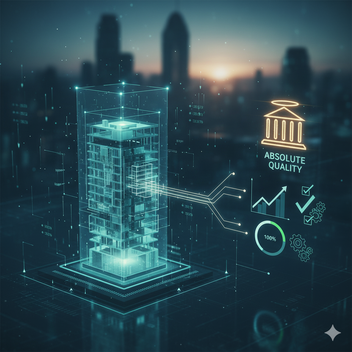
This approach enables us to develop a single, shared digital model — a “Digital Twin” — governing the entire asset life cycle, from concept to operation, and ensuring consistency, efficiency and full quality control.


1. Beyond the Tool: Our Integrated Approach
For us, BIM is the project’s central nervous system. It provides a common language that enables our architects, structural engineers, building services engineers (MEP) and project managers to work in step from the earliest stages.
We move beyond the traditional separation of disciplines. Our BIM model brings together, in real time:
-
Architectural intent (spaces, forms and materials).
-
Engineering analysis (structures, performance and building services).
-
Management variables (time, cost and maintenance).
Each design decision is therefore validated simultaneously by all the disciplines involved, eliminating inconsistencies at source and optimising every aspect of the project.
2. The BIM Workflow at Gaspare Verna S.p.A.
Our integrated project management activities (Italian ATECO classification 71122) translate into a structured BIM workflow, with each dimension adding a further level of control.
Design and Coordination (3D)
Three-dimensional modelling underpins our integrated design approach. Our architecture and engineering teams work on federated models to prevent clashes proactively (clash prevention), rather than merely identifying them (clash detection). This ensures that the design is fully buildable.
Sustainability by Design (6D)
In keeping with our membership of GBC Italia, sustainability is integral to the model. We carry out energy and environmental impact assessments (LCA) directly on the digital twin to optimise building performance and inform design decisions, supporting certification schemes such as LEED.
Time and Cost Control (4D and 5D)
We link the 3D model to the construction programme (4D) and the bill of quantities (5D).
-
4D Planning: We simulate construction stages, optimise site logistics and monitor progress to ensure that deadlines are met.
-
5D Control: We produce accurate, dynamic quantity take-offs (QTO). Any design change automatically updates cost estimates, ensuring rigorous, transparent budget control.
The Connected Site and Asset Operation (7D)
The BIM workflow extends its benefits into construction and beyond.
-
Office-to-Site Integration: Our site teams access up-to-date models on mobile devices, ensuring that construction remains fully aligned with the validated detailed design.
-
Facility Management (7D): We deliver an as-built model containing all technical information, including data sheets, manuals and warranties. This makes the model an active management tool for maintenance and building optimisation throughout the asset life cycle.

3. The Results of Our Integrated Process
Our methodology is designed to deliver tangible, measurable results that define the quality of our work.
-
Complete Design Consistency Integrating architecture and engineering from the outset eliminates compromises and inconsistencies between aesthetics and functionality.
-
Efficiency and Resource Optimisation Resolving issues digitally, rather than on site, substantially reduces unforeseen events, material waste and costs arising from changes during construction.
-
Control and Predictability Integrated data management (3D, 4D and 5D) provides a clear, predictive view of project progress, ensuring certainty over outcomes, schedules and budgets.
-
Construction and Operational Quality An error-free design and a detailed as-built model result in properly executed construction and an asset that is easier and more economical to manage over time.
4. Standards, Technology and Expertise
Excellence in BIM requires ongoing commitment. Our processes are aligned with the most rigorous international standards, including the ISO 19650 series, and supported by our management system certifications (ISO 9001, 14001 and 45001). We continually invest in specialist training for our multidisciplinary teams and in advanced Common Data Environment (CDE) platforms to ensure a collaborative, secure and innovative workflow.


CERTIFICATIONS
ISO 9001:2015
ISO 14001:2015
ISO 45001:2018
SA 8000:2014
ISO 30415:2021
UNI PDR 125:2022
ISO 37001:2016


TOP 200 ENGINEERING COMPANIES 2022–2025

